Nobody Can Freeze It, So Nobody Can Give It Back — What Sits Inside CAW's Own Contract
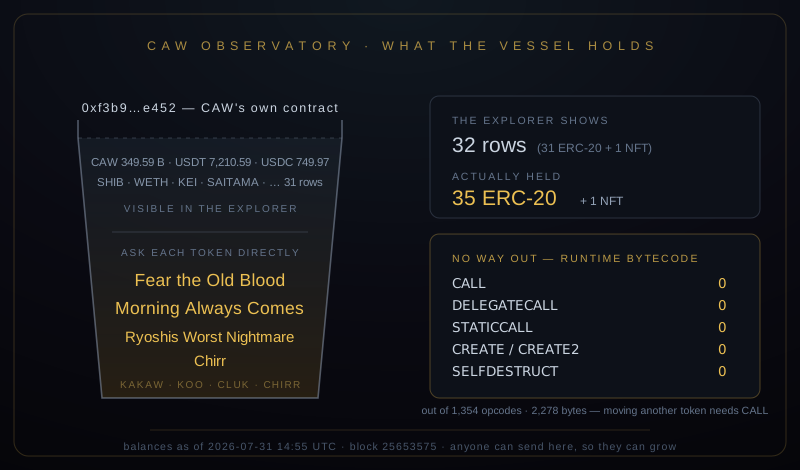
CAW's contract has no owner. No mint, no pause, no blacklist (see the archive entry "CAW's Vessel — Twin Contracts Born From the Same Mold"). Nobody can freeze your balance. Here is the flip side of that: nothing that lands in this vessel by mistake can ever be handed back. ❶ So we counted what is inside. CAW's own contract address holds 35 different ERC-20 tokens plus one NFT: 349.59 billion CAW, 7,210.59 USDT, 749.97 USDC, just over 10 million SHIB. ETH: none — and it could not take any if someone tried, because the contract has no `receive` and no `fallback`. (As of Jul 31, 2026, 14:55 UTC, block 25653575. Anyone can send here, so they can grow.) The explorer's list stops at 32 rows; the remaining four surface only if you ask each token contract directly (`balanceOf`). Their names: Fear the Old Blood, Morning Always Comes, Ryoshis Worst Nightmare, and Chirr. The first two are lines from Bloodborne — the same source as A Hunters Dream, which is CAW's own full name. There are also 6,666,666,666 units of a token named simply `Judas`: the same run of sixes as the total supply. ❷ Why can none of it come out? "There is no withdraw function" is the weak version of that answer, so we read the code that actually runs. In 2,278 bytes and 1,354 instructions there is not a single `CALL`. Moving even one unit of another token means calling that token's contract. This vessel was never given the instruction. ❸ Here is where it gets strange. Open the address in an explorer and you will find 532 outgoing rows, from a contract that cannot send anything. 523 of them are a token called `HUM`, and this address has never received a single HUM and holds none of it. You cannot send 523 times what you never had. What actually happened was one transaction, on Apr 18, 2022, in which HUM's own contract emitted 523 events saying the sender was this address. ❹ The same thing happens with the NFT. The one NFT sitting here, `A Hunters Dream Mysterybox NFT` (symbol: `caw.gift`), displays CAW's deployer as the sender. Someone else sent it: the transaction that created that contract carries the deployer's address written straight into its arguments — the sender is a field whoever deploys gets to fill in. The deployer's own signatures number 16 in total, the last on Oct 31, 2022, and this NFT was created 386 days after that. Transfers and approvals revert when called, and asking it for a balance returns 1 for every address you try — there is no ledger of owners at all. Its description offers to let "holders of the CAW NFT" exchange it for CAW rewards; CAW is an ERC-20, and no such thing exists. So here is the practical part. Leave the NFT where it is. Transfers and approvals cannot even be called on it, so nothing is going to happen inside your wallet. The one thing to be careful with is the website its description points to — we did not open it, so what happens there is unverified, and there is no reason to connect a wallet, or to sign what it asks for, on a site nobody has checked. Not opening it is the safest answer. None of this was aimed at CAW either: the same `<project> Mysterybox` build shows up more than 30 times on the first page of an explorer search, and the same trick has landed on SHIB's contract and on LINK's — a mass-production kit reading holder lists by machine. This vessel was on that list because it holds 349.59 billion CAW. ❺ One thing to be plain about: the CAW sitting in here is not subtracted from the total supply. CAW's total is a fixed 666,666,666,666,666, and these 349.59 billion are still counted inside it. Out of reach is not the same as gone. Why we saved this: what the chain preserves is who signed — not who a record says sent it. The 523 sends say it. The delivered NFT says it. A display is something anyone can write; a signature is not. And when the counting was done, what lay deepest in the vessel were words from the same place CAW's own name came from. Nobody knows who sent them, or why. Probably nobody can take them out. They are simply there — Fear the Old Blood, and Morning Always Comes. 🐦⬛
Source
publicnode RPC (eth_call / eth_getCode) · Blockscout · IPFS ↗