On the Day of the All-Time High, 17 Numbers Were Chosen by Hand
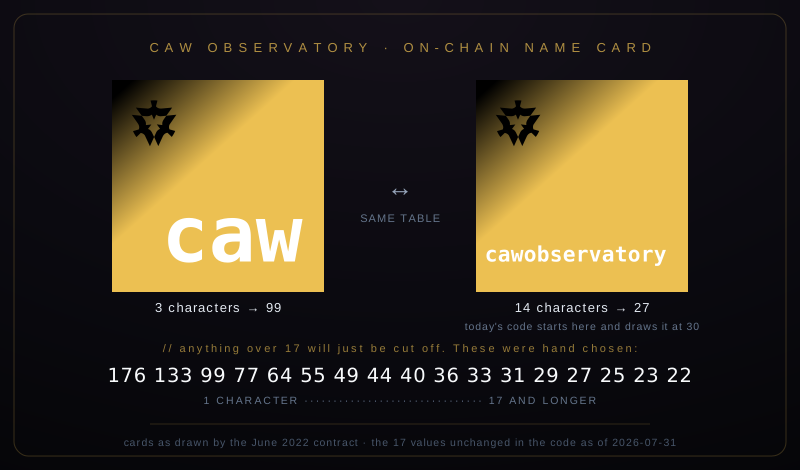
On June 4, 2022, CAW hit its all-time high — about $0.000000164 at 18:14 UTC, roughly seven weeks after launch, still with no website, no whitepaper and no official team. There is a record of that same day from somewhere else entirely, and not one line of it is about the price. ❶ The repository had been created two days before, on June 2 — the repo that today's CAW codebase is forked from. June 2, June 3, June 4: the contract that draws a CAW NAME, the square card you get when you hold a CAW username as an NFT, entirely on-chain, was written across those three days. ❷ The file itself was born at 18:46 UTC on June 3, 2022. The table of font sizes was already in it — as comments: 169 for a 1-character name, 149 for two, 99 for three, 17 rows in all. The code, though, produced lengths 13 through 17 from a formula — `35 - length` — and only the shorter names were written out one at a time. And that formula disagreed with the author's own table on three of those five rows (at 15, 16 and 17 characters). ❸ An hour and a half later, the commit at 20:16 UTC on June 3, 2022 says only "Added shadows to the logo". The logo did get its shadow. And in the same commit the formula was thrown away: 13 through 16 were written out one at a time, like the shorter names already were. The values taken were not the formula's output but the table's. The 17 rows of comments vanished, and where they had been, a single line was left: `These were hand chosen:` ❹ The next morning, the commit at 09:10 UTC on June 4, 2022 — "made a few improvements to the styling…" — chose 16 of the 17 rows again. One was left alone: 99, for 3-character names. A flat spot where both 6 and 7 characters had been given 42 was resolved here too. About nine hours later, the high came. ❺ And now. Development passed to someone else in 2024 (the timeline entry "The torch passes"), the contract was renamed, and the part that draws the letters was rebuilt: today's code carries 54 glyph shapes on-chain — 36 for letters and digits, plus 18 ligatures — picks which ligatures to use, and fits the text to the width. Yet the card is still 270 by 270, the logo paths have not changed by a single character, the baseline the text sits on is the same, and so is the description, typo and all. And sitting inside it is the table: 176, 133, 99, 77, 64, 55, 49, 44, 40, 36, 33, 31, 29, 27, 25, 23, 22. All 17 match the values from 09:10 UTC on June 4, 2022 exactly (checked against the code as of Jul 31, 2026). And not in one place: twice in the contract, and twice more in the code that draws the screen. These 17 are a starting point, not the size that ends up drawn. From there today's code adds 3 for every narrow letter (i, j, f, l, t), then squeezes to the width if it still overflows. We ran this observatory's own name through the deployed contract: cawobservatory is 14 characters, so 27 from the table, plus 3 for its single `t` — what is actually drawn on-chain is 30. ※ Every time above is written in UTC. But the times recorded in the commits (the Git author date) carry an offset of +07:00, and on that clock all three fall on one day, June 4 — the file made at 01:46, "hand chosen" written at 03:16, the rows chosen again at 16:10. In UTC it reads as the night before and the next morning; on that clock it reads as one continuous day. Two readings of the same record, and we cannot say which one was the lived one (the same signature recorded +02:00 that October). All three commits carry the same Git author identity, though whether that is one person we cannot confirm. They also show signs of having been rewritten together afterwards — all three carry the same recorded time, down to the second — so we cannot confirm anyone was at a desk at those moments. And we do not connect the price to this work (causation unconfirmed): two things happened on the same day, and we are only setting them side by side. One more thing worth saying plainly: this username NFT currently runs on the Sepolia testnet. What lives on Ethereum mainnet is the CAW token itself. Why we saved this: the day of an all-time high usually leaves nothing behind but the price — a dot at the top of a chart, and that is that. But on that same day there was a hand choosing, one number at a time, how large the letters should be for whoever manages to get a 1-character name (176), or a 2-character one (133). No sign remains that anyone asked for it, and the record of that day's price carries none of it. So there are two records of that day: the dot on the chart, and 17 numbers. Try typing caw. What comes back is still 99 — the one number left alone that morning, untouched in the four years since. And every one of the 17 is still there, including the ones held for names nobody has taken yet. 🐦⬛