Delivered Is Not the Same as There — A Gift of 500 Trillion, Performed Without Moving a Single Token
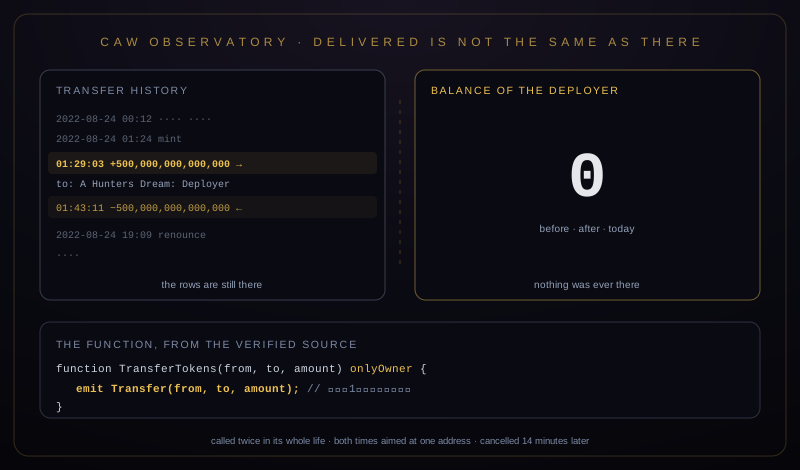
A row on the chain says 500 trillion tokens arrived at the wallet that created CAW. They were never there. The balance was zero from start to finish. ❶ On August 24, 2022 at 01:29:03 UTC, a token calling itself Babylonian issued a record — a Transfer event — announcing it had "sent" 500 trillion tokens, exactly half of its own supply, to the CAW deployer. Open the transfer history in an explorer and that row is still on the page (as of Aug 4, 2026). ❷ But no balance ever moved. The token's contract is verified, so its source can be read, and the "send" function inside it rewrites no ledger at all — it only issues the announcement — and only the owner may call it. The announcement travels in exactly the same format as a real transfer, so in a history listing the two are indistinguishable. Ask for the deployer's actual balance — the moment before, the moment after, or today — and the answer is 0. ❸ Fourteen minutes and eight seconds later, the same function was called once more, in reverse: an announcement that the same 500 trillion had been "returned". Later that day, ownership itself was renounced — and with it, the function became impossible for anyone to ever call again. The performance was two acts, out and back, closed forever. And the recipient, first and last, was the CAW deployer alone: count all 485 Transfer events this token ever produced, and no such "gift" was fired at anyone else. ❹ Then why? The apparent clue is a plaintext message sent to the deployer the same night: "Ancient Babylonian Number System Had No Zero". It reads like a cryptic oracle. The reveal is anticlimactic. The very same sentence sits at the top of the token's own source code, written there by its author — and directly beneath it, the address of their X (Twitter) account, which had been running for about 8 hours before the token was created. Not an oracle. An advertisement. ❺ Nor was the trick itself this token's invention. Count everything the deployer's address has ever received, and at least 12 tokens planted the same phantom balances — JIGOKU, OWARI, YUME夢, KARASU — a cluster of Japanese-named tokens, different hands holding the same distributed tool. Messages with text attached number 53 across the deployer's lifetime. No reply has ever come — and the letters and the gifts kept arriving anyway, as if the silence itself were the draw. Yet set the 12 side by side, and this one stands apart: the scale is of a different order (the second largest nets out around 660 thousand tokens), it fired exactly twice, at exactly one recipient, and cancelled itself 14 minutes later. Not a spray — a performance staged for a single viewer, with the curtain pulled at once. ❻ Through all of it, the CAW deployer did nothing. Sixteen signatures for life, unchanged. A name used, an address targeted, no reply given — that is all. Why we saved this: what the chain keeps is who signed — the vessel entry ("Nobody Can Freeze It, So Nobody Can Give It Back") checked the same thing from another side. A row that says "delivered" can be issued by anyone. A balance that says "it is there" can be staged by no one. Which cuts the other way, too: phantoms stay in the record as phantoms, and what is real stays as a balance. The CAW in your wallet is the latter — not a row someone issued, but a balance nobody can stage. One more thing. Three years and nine months later, CAW's V2 development testnets were given the names Uruk and Babylon. No thread connecting that night to those names has been found anywhere in the record (the actor behind the performance has been silent since October 2022). And yet, within this story, "Babylon" has now appeared beside CAW twice — once as a phantom gift, and once as the name of a place actually being built. What the second appearance brings with it, nobody yet knows. 🐦⬛