Only the Raven Did Not Come Back — When Not Returning Was the Good News
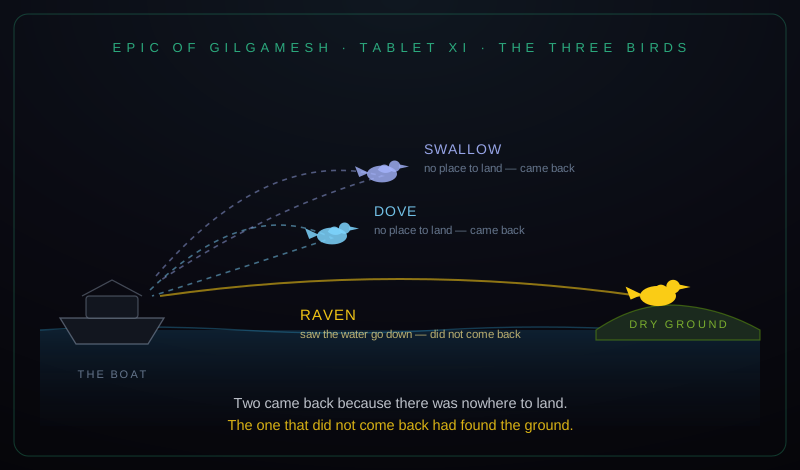
The oldest flood story humanity wrote down sends out three birds — and only one of them does not come back. ❶ The order: In Tablet XI of the Epic of Gilgamesh, Utnapishtim, who has survived the flood, releases a dove, then a swallow, then a raven, to find out whether the water has gone down. The dove flies off, finds no place to land, and comes back. The swallow does the same. The raven, released last, sees the water receding, eats, hops about, and does not come back (Stephanie Dalley's translation, 1989). So the two that returned were the message 'there is still nowhere to land', and the one that did not return was the message 'there is ground'. In this story, the absence is the good news. ❷ A sound that survives in one English version: N. K. Sandars renders the moment like this — "she ate, she flew around, she cawed, and she did not come back." The cawing is the translator's choice: another English version (Andrew George) has the bird bowing and bobbing, with no cry at all. So we cannot say the word is on the tablet. What we can say is that in one English rendering of the oldest story we have, that sound got written down once. ❸ Why it stayed away: the reason looks ordinary rather than mystical. The receding water uncovered ground with food on it, and a bird that eats carrion had no reason to come home — that is a scholar's reading (Darshan 2017). The tablet itself does not give a reason; it records only the behaviour, eating and bobbing up and down. And sending birds out to look for land was a real navigational practice: Pliny writes in Book VI of the Natural History that sailors carry birds aboard and let them go, again and again, when they are looking for land (from the 1601 English translation). ❹ The same reading, far later, in a northern sea: the Norse voyager Floki took three ravens aboard in the Faroes. The first flew back the way they had come. The second went up into the air and returned to the ship. The third flew off to the northwest and did not come back — he steered that way, reached the land, and named it Iceland. The nickname stuck too: Hrafna-Floki, Raven-Floki (from the Landnamabok; the year itself is not settled). ❺ Where CAW touches this, it touches only the names: the GitHub account that holds CAW's code is called GilgameshCaw, and V2's development testnets are named Uruk and Babylon — both ancient Mesopotamian cities, and Uruk is the city Gilgamesh rules in the epic (already on the timeline at May 21, 2026). No one behind those names has ever explained the choice, so we are not joining the two here. That the flood and the raven happen to be carved on the eleventh tablet is likewise just set down beside it (the hidden poem in this board's entry 'The Gilgamesh Tablet' claimed the original eleven are the true ones). Why we saved this: the first line a human being ever wrote about a bird that did not come back is not a sad line. Two came back because there was still nowhere to land; one stayed away because it had found somewhere to land. Not coming back does not always mean lost — at least not in the oldest story we kept. The line is still sitting there on a tablet written more than three thousand years ago. 🐦⬛